
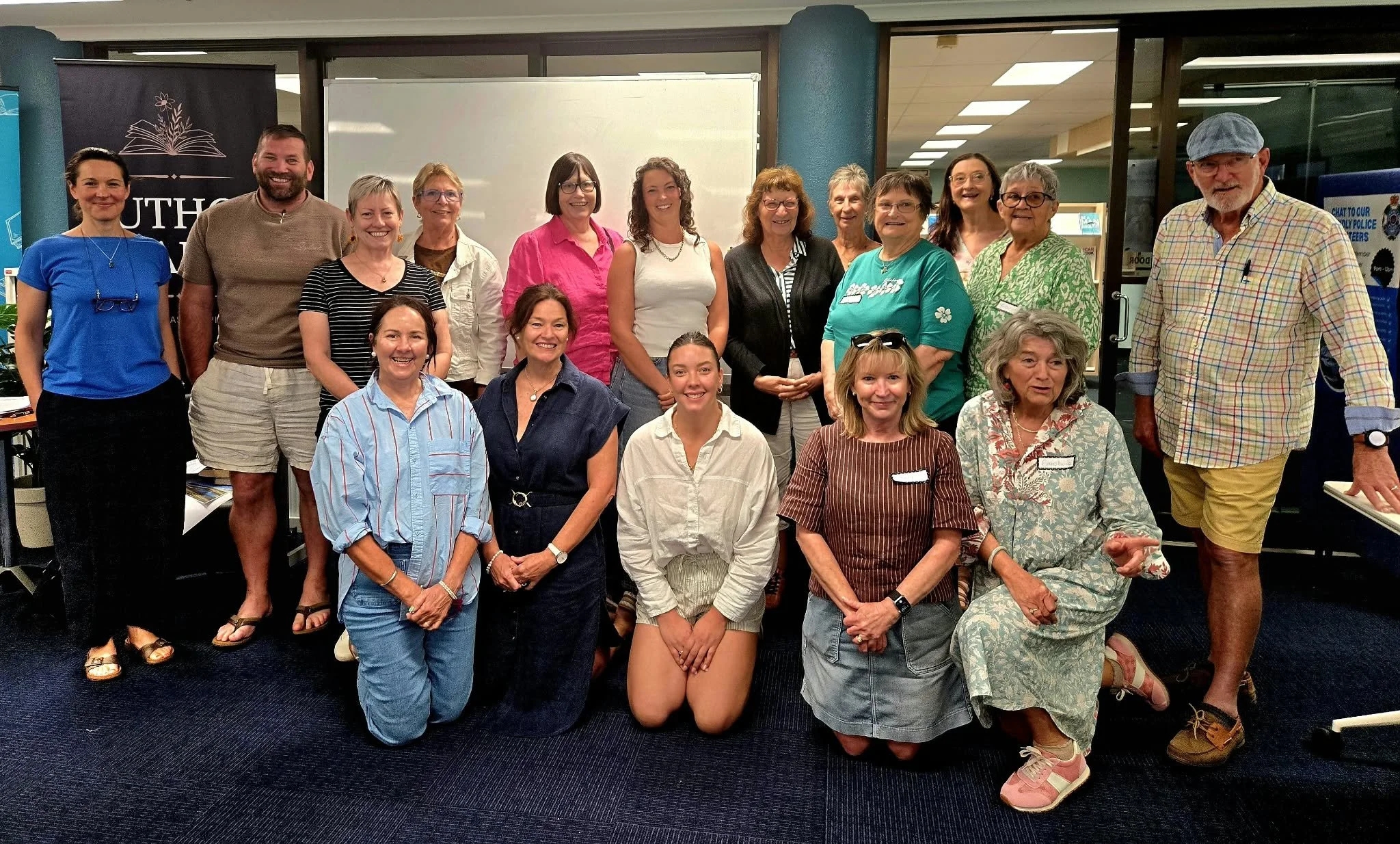
Thirty days. Twelve towns. About 5,000 km around western Queensland.
By the end of the memoir-writing tour, I had learned that it really doesn’t matter how loudly, or how badly, you sing in the car… when you’re alone. It is, in fact, quite liberating.
I also came home with something a touch more important: an even stronger conviction that rural and regional Australians hold a rich social history in their memories, and too much of it remains unwritten.
The tour took me through Charters Towers, Hughenden, Richmond, Mount Isa, Winton, Longreach, Charleville, Mitchell, St George, Roma, Maryborough and Yeppoon.
In every place, people arrived with the same barriers to writing their life stories.
“My life isn’t interesting.”
“Nobody would be interested in my story.”
“I don’t know where to start.”
“I left school early. I’m not a writer.”
Then the memories began surfacing, and within a couple of hours the room would be full of vivid stories.
Some women had worked as remote midwives, helping bring babies into the world far from major hospitals. Mothers spoke about teaching their children at home on isolated properties through radios and correspondence papers.
There were stories of droving cattle, leading shearing teams across western Queensland, living in tents as children, shooting cattle after floods and sheep during droughts, and American soldiers throwing lollies and chewing gum to children through train windows during the war.
People remembered outdoor picture theatres covered in bugs, bullock teams building bore drains, long railway journeys, end-of-war celebrations, and life in the bush before electricity.
There was a church minister who travelled enormous distances, a local newspaper writer recording the life of her town, and an artist who spent years travelling around pastoral properties painting portraits and landscapes for her clients.
Some stories were funny. Some were heartbreaking. Some began with, “Oh, this probably isn’t worth telling, but ...”
And those “but” stories are often the ones most worth preserving. They are also the easiest to lose.
When you write a memoir, you are not obliged to write everything that ever happened to you. You write the stories that shaped you. The people, places, hardships, joys, mistakes, losses and lessons that changed how you saw the world, or yourself.
Once people understand that, memoir becomes less overwhelming. They stop trying to summarise an entire life and begin looking for the stories that mattered.
I often heard people, particularly women, dismiss their life experiences because they were “normal”.
Milking the cow every morning because the family needed milk.
Mum cooking on a wood stove.
Dad disappearing for weeks with the other shearers.
At the time, it was simply life.
Only later, when the world has changed, and those routines have vanished, do we realise that the small details were the texture of a time and place. And by then, the people who remember them may no longer be here to tell us. That is how whole parts of our social history disappear: unnoticeably, one unrecorded life at a time.
I noticed something else on the tour.
The writing was only part of what happened in the room.
People laughed. They remembered together. One story sparked another. Someone would begin with a small memory and, within minutes, half the table would be nodding or adding a story of their own.
There was a generosity in that sharing. People listened. They encouraged one another. They recognised pieces of their own lives in someone else’s. And they didn’t want it to end.
In many towns, participants began talking about meeting again each month to keep writing together. I love that.
A workshop can prompt someone to start, but a local memoir group can keep the writing going while also creating connection. Around a table, stories become more than words on a page. They become conversation, laughter, recognition and sometimes the beginning of friendship.
I’m grateful to the libraries that have welcomed these groups. They have become places where local stories are not only stored, but written, shared and kept alive.
My goal was never to run a workshop, pack up the pens and drive to the next town. It was to help people see that their lives are worth recording, give them practical tools to begin, and hopefully leave something behind that keeps growing long after I’ve gone.
The tour also reinforced to me that memoir doesn’t require an epic life. You don’t need to be Crocodile Dundee or the Man from Snowy River to have a memoir worth writing.
Memoir asks you to recognise the experiences that shaped you, and understand why they mattered. Often, those stories are found in the way people lived.
What they cooked.
What they feared.
How they worked.
Who they loved.
What happened when the floodwater receded.
What the town was like before mining began.
How a family managed when times were hard, and how they enjoyed the good times.
A life does not have to be unusual to be worth writing about.
Milking a cow before school, teaching children by radio, travelling for weeks with a shearing team, or sitting in an outdoor picture theatre cursing the bugs on the screen may seem ordinary to the person who lived it. But if an experience changed you, stayed with you, taught you something, or became part of who you are, it belongs in the memoir.
And taken together, these individual stories tell a much larger one. They tell us how rural and regional Australians lived, worked, raised families, endured hard times, adapted to change and built communities.
They are part of Australia’s social history. And they are disappearing too quickly.
Along with a possible touch of hearing damage from my car music, I returned home with renewed motivation to help preserve the stories of rural and regional Australia.
The stories are rich and abundant. Of that, I have no doubt. The challenge is helping people recognise their value, and write them down before they disappear.
The Stories That Shape Us tour was supported by the Queensland Government through Arts Queensland.
I am grateful for that support, and for every library, host and participant who pulled up a chair and shared a story.
